

Burnham's 'Your First Home' Scheme: A 2.5% Deposit. Your First Home. What’s the Catch?
Could a 2.5% deposit unlock your first home? We explore Andy Burnham’s 'Your First Home' scheme, who it aims to help and why it only covers new builds. With industry reaction and his own views on the benefits and drawbacks, he looks beyond the headline to ask whether this is a helping hand for buyers and what questions still need to be answered
Saving for your first home while paying rent can feel like running up an escalator that is coming down. You put money aside, everyday costs swallow the rest, and the deposit still feels miles away.
Andy Burnham’s newly announced Your First Home scheme aims to make that first step easier. The headline is certainly attractive: buying a new home with a deposit of just 2.5%.
There is plenty to welcome, but a smaller deposit is only part of the story. Here is what we know, what the property industry thinks and where I believe buyers need to look carefully.

What is 'Your First Home'?
The government has announced a proposed equity loan scheme for first time buyers in England purchasing a new build from a participating developer.
The outline includes a 2.5% buyer deposit, a 20% government backed equity loan and an initial period without interest on that loan. Household income limits and local property price caps will apply, with the figures still to be announced.
For an illustrative £200,000 purchase, the proposed structure would look like this:
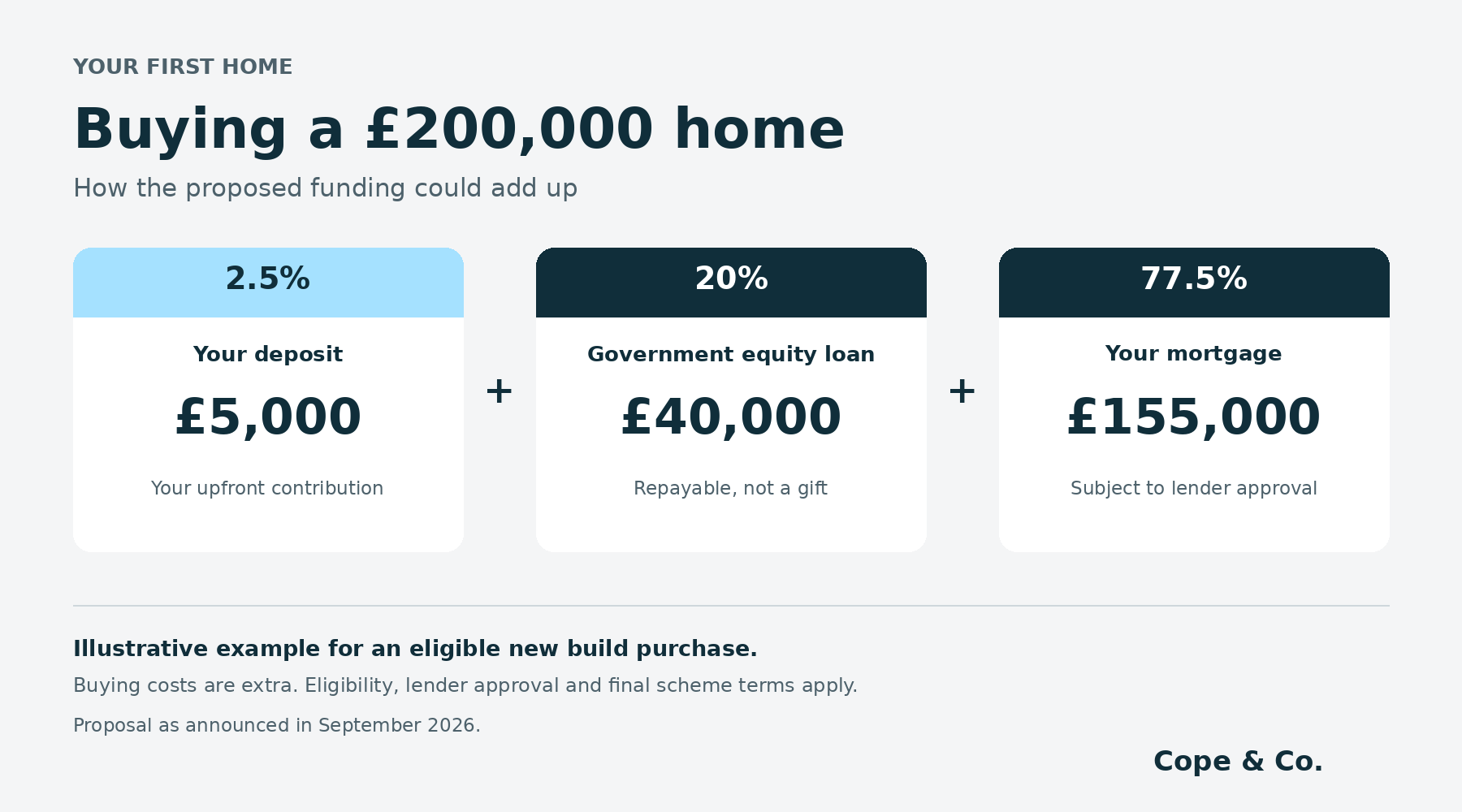
This example assumes the property and buyer qualify and a lender approves the mortgage. Buying costs would be additional.
The £40,000 is a loan, not a gift or a discount on the property. You would have a mortgage and a separate equity loan to deal with.
Full details are expected at the Budget on 28 October. The length of the interest free period, subsequent charges, repayment arrangements and participating lenders have not yet been confirmed. Buyers cannot currently apply.

Who is it aimed at?
The intended audience is people who could sustain homeownership but struggle to accumulate the upfront deposit, particularly without family financial help. The government says it wants support to reach buyers who could not otherwise afford their first home.
Think of someone earning regularly and paying rent each month, but finding it difficult to build savings alongside their living costs.
However, a smaller deposit will not automatically make someone eligible for a mortgage. Income, existing borrowing and affordability will still matter. Passing the scheme’s eligibility rules and obtaining mortgage approval are separate hurdles.

Why is it only for new builds?
The government has two objectives; helping buyers and encouraging construction. Its announcement explicitly links the scheme to supporting the new build market and increasing housing supply. Developers will also contribute towards the scheme’s costs.
The commercial logic is straightforward. If more people can buy the homes developers produce, builders should have greater confidence to proceed with further construction.
Buying an existing house transfers a home between owners. Buying a new build also supports the market for additional housing. That explains the restriction, although it does not automatically make it the fairest approach for every buyer.
It also means the scheme’s usefulness locally will depend on which developers participate and whether their homes meet the eventual price limits.

What does the property industry think?
The early response combines support with some pointed questions.
There are some arguments that planning reform alone cannot deliver the government’s housing ambitions and that carefully targeted help for buyers could support ownership and give developers confidence to build.
There are also questions about the scope of the scheme. Several commentators argue that the previous Help to Buy scheme benefited builders particularly strongly and would prefer support to extend to existing homes.
Others welcome action on affordability but warn that very small deposits can leave buyers exposed to falling prices, particularly if they have paid a premium for a new property.
My view: is it a good idea?
In principle, yes.
I like the intention of helping people whose biggest obstacle is saving a deposit. Whether you can buy a home should not depend so heavily on whether your parents can write you a cheque.
Halving the deposit requirement from 5% to 2.5% could bring the starting line much closer. On our £200,000 example, that means finding £5,000 rather than £10,000, before buying costs.
I also understand the argument for linking assistance to housebuilding. Helping buyers and encouraging more homes could be a useful combination.
However, I would judge success by whether people achieve sustainable homeownership. Getting the keys is the beginning. Being able to afford the property comfortably several years later is what really matters.
My view: what are the downsides?
My biggest reservation is the restriction to new builds.
For a buyer looking around Derby, Alfreton or the surrounding towns and villages, an existing home may suit their budget, location and circumstances better. I would not want someone to dismiss a suitable property simply because a different home comes with government assistance.
There are three further issues I would want buyers to understand.
A smaller deposit does not mean a cheaper home. Compare the total purchase price and ongoing costs, rather than choosing primarily on the cash needed upfront. My concern is that extra buying power could support higher prices if construction does not respond quickly enough.
The equity loan needs an exit plan. Under the former Help to Buy scheme, repayment was linked to the property’s market value. A 20% loan on a £200,000 home was £40,000 initially, but repaying 20% when the home was worth £250,000 meant £50,000. That illustrates why the terms matter; we must wait to see the exact rules for Your First Home.
Buyers need breathing room. Starting with a small deposit leaves less protection against a fall in value. Future loan charges, maintenance and any estate or service charges also need to fit comfortably within the household budget. The HomeOwners Alliance has highlighted these affordability considerations in its initial assessment.
My position is cautiously positive. I support help that gives more people a realistic route into ownership, but I would want clear repayment terms, sensible property pricing and proper advice built around the buyer’s circumstances.

Thinking about buying your first home?
At Cope & Co., we can help you compare properties across Derby, Alfreton and the surrounding areas and understand what your budget could buy. Alongside advice from a mortgage adviser, that gives you a stronger starting point for deciding whether this scheme, once available, is right for you.