

Buying Your First Home in Alfreton? What’s It Costing You to Wait?
Waiting for mortgage rates to fall before buying your first home in Alfreton? It might feel sensible, but delaying can carry a cost of its own. We explore how monthly rent, repayments and property prices affect your long-term financial position, why timing the market is so tricky, and how to decide whether buying now or waiting makes sense for you.
“Let’s give it another six months.”
If you’re thinking about buying your first home in Alfreton, that might sound familiar. Perhaps you’re waiting for mortgage rates to fall, hoping prices will ease or simply wanting the whole decision to feel a little less daunting.
Buying a home has rarely felt like a straightforward decision, and the present market is no exception. Mortgage rates remain higher than many buyers became accustomed to during the 2010's, household finances have been squeezed by inflation, and the economic outlook continues to provide enough uncertainty for prospective purchasers to wonder whether they would be better off waiting for conditions to improve.
That instinct is totally understandable. Buying your first home for 99.99% of people is likely to be the largest financial commitment they ever make, so the fear of buying at the wrong point in the cycle can be very powerful.
Yet waiting is not a neutral decision. While someone remains on the sidelines, rent continues to be paid, the property market continues to move and the opportunity to reduce a mortgage balance is postponed.
The debate is often framed too simply as a choice between buying now or waiting for cheaper mortgages and lower house prices later. In practice, nobody knows with certainty where either will be in six months, let alone several years. What can be examined, however, is what happened to buyers who faced similarly uncomfortable decisions in previous periods of economic uncertainty.

Uncertainty in the property market is nothing new
In 1979, mortgage rates reached levels that would be almost unimaginable to many borrowers today. The wider economy was struggling with high inflation and industrial unrest, and buying a home would hardly have felt like the safe option. Yet those who were able to sustain their mortgage payments were gradually reducing the amount they owed while inflation and rising wages changed the real burden of that debt over time.
The same pattern of anxiety returned in 1992. Black Wednesday brought a dramatic sterling crisis and interest rates were briefly pushed sharply higher. Then, in 2007 and 2008, the financial crisis delivered a very different shock, with house prices falling and confidence disappearing from the property market. Someone buying an Alfreton home shortly before that downturn would have watched its value decline in the following 18 months by between 16% and 20%, depending on the type of property.
For those Alfreton homeowners, the short term experience was undoubtedly painful. But property ownership is rarely a one year decision. Buyers who remained in homes they could afford continued paying down their mortgages, and over the longer term the market recovered. The pandemic then provided another reminder of how difficult short-term forecasting can be. In 2020/1, there were widespread expectations of a severe housing downturn, yet activity and prices subsequently rose sharply once restrictions eased.
None of this means Alfreton house prices always rise or that every purchase is automatically a good one. Property values move in cycles, and there will always be periods when some owners see the value of their home fall. The broader lesson is that conditions which appear decisive in the moment often look far less important when viewed over five, ten or twenty years.

Why waiting to buy your first Alfreton home can carry a cost
For Alfreton first-time buyers, the alternative to buying is usually continued renting and the two forms of housing expenditure work very differently.
Rent pays for the use of a home for a given month, while a repayment mortgage combines an interest cost with a gradual reduction in the outstanding loan. Over a short period the difference can appear modest, but over several years it can become substantial.
There is also no guarantee that waiting makes housing cheaper. Rents can rise, property prices can rise, and the deposit required to buy can increase with them. Mortgage rates may fall, but a buyer who waits for a cheaper mortgage rate could find that the property itself costs more by the time those lower rates arrive. Equally, prices may soften while borrowing costs remain elevated. The variables rarely move neatly in the same direction.
For that reason, trying to identify the perfect moment to buy is an exceptionally difficult strategy. The bottom of a market is only obvious with hindsight, and by the time confidence has returned sufficiently for buyers to feel comfortable again, competition may already have increased. A more useful question is whether the buyer is financially ready, whether the property is reasonably priced and whether the monthly commitment remains affordable under sensible assumptions.

What five years of ownership in Alfreton could look like
• According to the Land Registry, the typical first-time buyer home in Alfreton cost £140,631 in August 2021.
• Let's assume a 5% deposit and a 30-year 95% loan-to-value (LTV) mortgage at 3.99%.
Over five years, that 2021 first-time buyer would have:
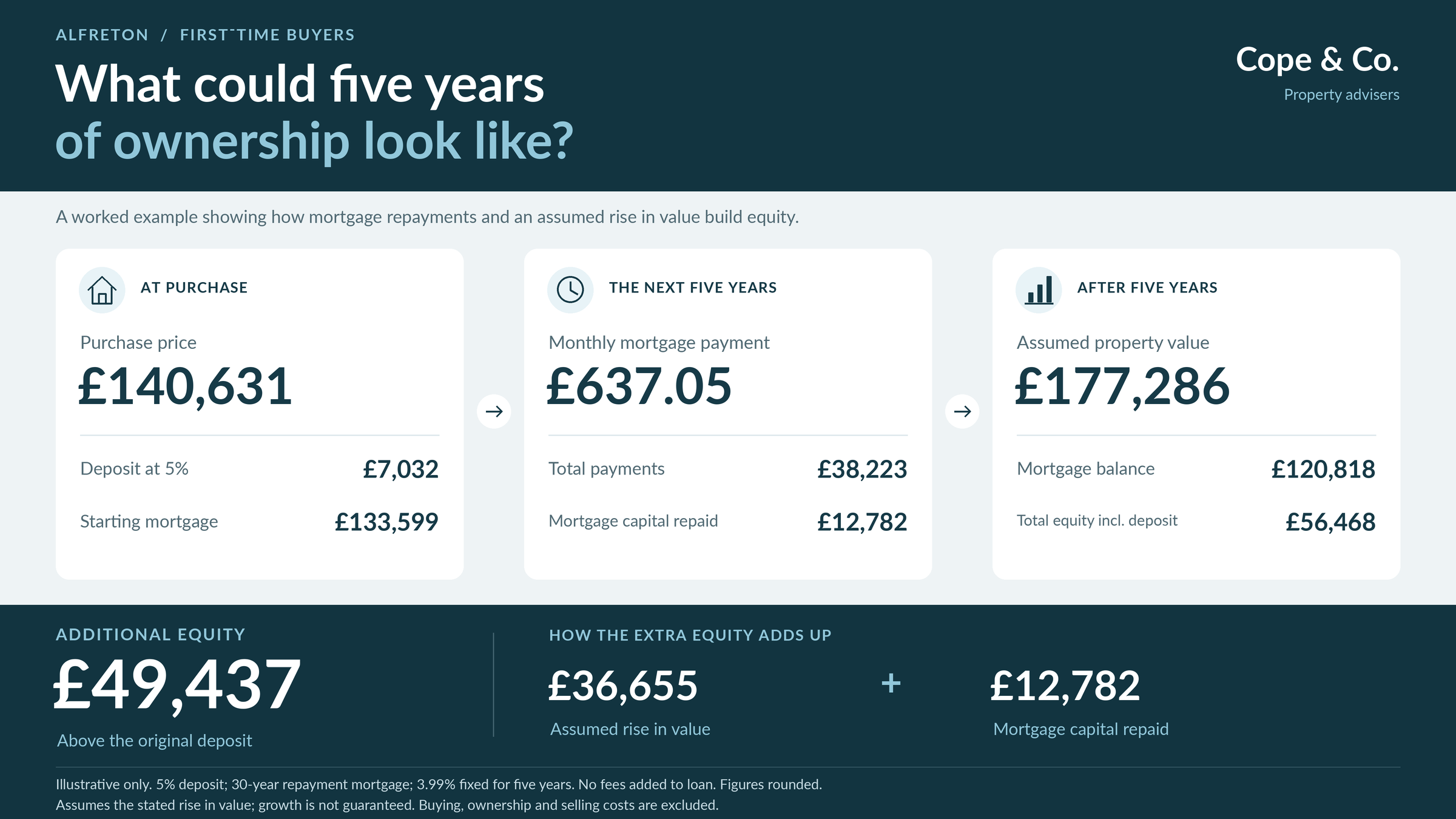
• Paid £38,223 in mortgage payments.
• Paid £12,782 of the capital element.
• Seen their Alfreton home increase in value to £177,286 (Land Registry).
• Therefore, building £49,437 of equity in their property.
• Their fixed rate would have come to an end in August 2026. So, assuming they remortgaged and didn’t borrow anymore, they would now have a 67% LTV mortgage. At the time of writing, the best rate for that level of LTV is 4.17%, meaning their monthly payments going forward are £635.39 per month.
Over the same period, the renter would have:
• Paid out potentially £44,760 in rent (rising from £611 pcm in 2021 to £881 pcm in 2026).
• Built nothing in return.
In a nutshell, not only has the Alfreton tenant paid £6.5k more in rent than the homeowner in mortgage payments - £38,223 mortgage payments vs £44,760 in rent, the homeowner has built up £49,437 in equity.
That is the real cost of waiting. Not just higher house prices today, but five years of lost repayments, lost equity, and lost momentum.

Buying vs renting in Alfreton - what the figures actually tell us
The figures do not prove that someone buying today will experience the same outcome as the buyer in 2021. They can't. The next five years will have their own combination of interest rates, wage growth, inflation and property price movements.
What the Alfreton comparison does show is how quickly the financial position of an owner and a renter can diverge once several years have passed.
The 2021 Alfreton buyer did not need to forecast the exact value of their home in 2026 to benefit from ownership. Part of the mortgage was being repaid from the first month, and the increase in the value of the property subsequently added to the owner's equity. The renter, meanwhile, received the housing service they paid for, but the monthly payments did not create an asset or reduce a future housing debt.
That distinction is particularly important when people talk about waiting for mortgage rates to fall. A lower interest rate is clearly beneficial, but it is only one part of the calculation. If someone delays a purchase for two or three years, the relevant comparison is not simply today's mortgage rate against a hypothetical future rate. It is the entire financial effect of renting for those additional years compared with owning during the same period.

Affordability still comes first
Let's be straight - building a deposit to even make buying a home is still very difficult and there are, of course, many perfectly sensible reasons to delay buying.
If you are somebody with uncertain employment, expensive unsecured debt or a mortgage payment that would leave little room in the household budget, you should be cautious. Or if you are a buyer who expects to move again within a short period, you also need to consider transaction costs and the possibility of short-term price movements.
For those who are financially secure and expect to remain in the same home for a number of years, however, the calculation changes. The emphasis becomes less about trying to predict the next movement in the property market and more about whether the home suits their needs, whether the price is fair and whether the mortgage remains manageable if circumstances change.
That is where mortgage advice and careful budgeting become more valuable than market predictions. Stress testing monthly payments if mortgage rates go up, allowing for ongoing maintenance and running costs, and retaining an emergency fund may not be as exciting as trying to call the bottom of the market, but they are much more useful safeguards for a first-time buyer considering a long-term commitment.
The cost of waiting to buy an Alfreton home is not only financial
Housing decisions are also about how people live, not just what appears on a balance sheet. Buyers often move because they need another bedroom, a garden, a better location for work or schools, or simply the stability of knowing they can remain in a home for as long as they choose. Delaying a purchase can therefore carry a lifestyle cost alongside the financial one.
For some Alfreton renters, postponement can become a repeated cycle. They decide to wait for six months, then another six months, while checking property portals and watching interest-rate forecasts. Several years can pass without the supposedly perfect moment ever becoming obvious. During that time, their personal circumstances may have moved on even if their housing situation has not.
That does not mean people should rush into buying. It means waiting should be treated as an active financial choice rather than the absence of one. If postponing a purchase is expected to improve a household's finances, build a larger safety buffer or create greater certainty, it may be entirely sensible. If the only reason is the hope that the market will eventually present a risk free opportunity, history suggests that opportunity may never arrive in the form people expect.

Moving home is a question of time, not perfect timing
The UK property market will always contain uncertainty. Governments change, economies slow and recover, mortgage rates rise and fall, and house prices respond to forces that cannot be forecast precisely. Home buyers have had to make decisions against that background for generations, and today's market is no different in that respect.
For most prospective Alfreton buyers, the more useful focus is therefore on the factors they can control. Can they afford the mortgage comfortably? Is the property priced sensibly compared with similar homes? Do they have enough savings left after the deposit and moving costs? And is this somewhere they could realistically remain for several years?
If the answers to those questions are positive, waiting purely for a perfect point in the property cycle may carry a greater cost than it first appears. The evidence from previous market cycles doesn’t suggest that timing is irrelevant, but it does suggest that the length of time spent owning a suitable home can matter more than buying in precisely the right month.
For Alfreton buyers who are ready, the decision is less about removing uncertainty and more about deciding whether the long-term benefits of ownership outweigh the short-term comfort of waiting. That is a judgement every household must make for itself, but it is worth making with the full cost of delay in view.
Do you agree with what I've said?