
Derbyshire Rents Are Rising... But September is About What's Coming Next
Rents are still rising across Derbyshire, but the story is far from uniform. September26 is our brand new Monthly Lettings Market Report which combines official rent data, achieved tenancy figures and live supply-and-demand evidence to show what’s really happening in the local rental market.. plus what landlords and tenants should be watching next.
Three layers. One clearer view of the rental market.
Rental market headlines can be confusing. One report talks about advertised rents. Another measures newly agreed tenancies. Official figures look across the wider private rented sector, and, depending on which number you read, you can come away with a very different impression of what's actually happening.
So, just as we do with our monthly Property Market Report, we have taken a three-layer approach. We start with confirmed national and regional rental trends. Then we look at the latest evidence across Derbyshire. Finally, we look at what is happening in the market right now, particularly supply, demand and tenant competition.
Plus, because looking backwards only tells half the story, we've added a section called 'What's Coming Up?' The result should give landlords and tenants a much clearer picture of where the market stands as we move through September 2026.

The rental market in 60 seconds
£922 pcm - Average private rent across the East Midlands in August. ONS regional rent inflation stands at 3.8% annually.
£938 pcm - Average rent for a newly agreed East Midlands tenancy according to HomeLet — 3.8% higher than a year ago.
£860 pcm - Average private rent in Derby, up 3.1% annually.
£799 pcm - Average private rent in Amber Valley, up 4.0% annually.
5.3 enquiries per available rental home - The latest national figure from Zoopla, as rental supply begins to tighten again.

Layer One: What are rents actually doing?
The broad picture remains positive for rental values. The latest ONS Price Index of Private Rents shows the average UK private rent reaching £1,400 per month in August, an increase of 3.8% over the year.
Across the East Midlands, the average monthly rent was £922, compared with £889 a year earlier. The ONS regional inflation measure puts annual East Midlands rental growth at 3.8%.
HomeLet's August Rental Index gives us a slightly different perspective because it focuses on newly agreed tenancies rather than rents across the entire private rented sector. Its UK average reached £1,382, up 4.1% annually, while the East Midlands recorded an average new-tenancy rent of £938, up 3.8% year-on-year and unchanged from July.
That alignment is particularly useful as the broader ONS market says East Midlands rental inflation is 3.8% and HomeLet's achieved-rent evidence for new tenancies also says 3.8%. Different datasets, different methodologies but very similar direction.
Our reading
Despite media headlines, rental growth hasn't disappeared. Equally, the evidence doesn't suggest a return to the extraordinary increases experienced during the most overheated part of the post-pandemic rental market. Instead, the East Midlands appears to be experiencing steady rental growth at around 4% annually.
For landlords, that makes accurate market evidence increasingly important. Simply adding a percentage to last year's rent doesn't tell you what an individual property is worth today. Location, property type, bedroom count, condition and the amount of competing stock all matter.

Layer Two: What is happening across Derbyshire?
This is where the report becomes particularly useful. ONS now provides monthly private rental evidence at local-authority level, allowing us to see just how different rental markets can be even within the same county.
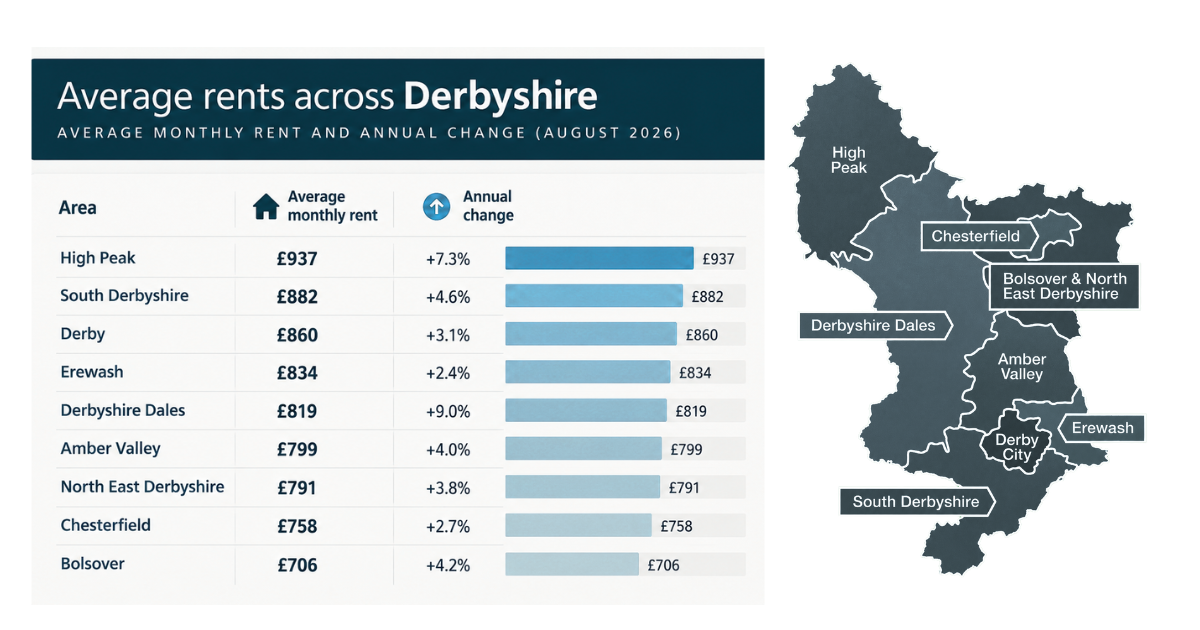
ONS rental data: August 2026. Local figures are based on smaller samples than national estimates, so ONS recommends considering trends over a year or longer rather than placing too much emphasis on short-term movements.
Derby and Amber Valley; a closer look
Given Cope & Co.'s operating areas, Derby and Amber Valley are particularly relevant.
In Derby, average monthly rents are currently:
🔹 One bedroom — £608
🔹 Two bedrooms — £778
🔹 Three bedrooms — £937
🔹 Four bedrooms or more — £1,302
In Amber Valley:
🔹 One bedroom — £584
🔹 Two bedrooms — £741
🔹 Three bedrooms — £914
🔹 Four bedrooms or more — £1,280
These figures underline why one headline figure for "the average rent" only gets us so far. A three-bedroom family home in Alfreton, a one-bedroom Derby apartment and a detached property elsewhere in the county aren't competing in exactly the same rental market.
That's why individual property evidence remains so important.
The standout local figures
The fastest annual rental growth in the latest Derbyshire data is in the Derbyshire Dales at 9.0%, followed by the High Peak at 7.3%. Closer to our core operating areas, South Derbyshire at 4.6%, Bolsover at 4.2% and Amber Valley at 4.0% are also recording notable annual increases.
That doesn't mean every property in those locations has increased by those percentages, but tt does demonstrate something important; Rental growth remains very much a local story.

Layer Three: What is happening right now?
The first two layers tell us what rents have been doing. Layer Three asks a different question; What is happening to supply and demand now, and what could that mean next?
September's Zoopla Rental Market Report gives us some useful clues. Zoopla reports that:
🔹 UK rents on new lets are 2.6% higher than a year ago
🔹 The number of available rental homes is 3% lower year-on-year
🔹 The flow of new homes coming onto the rental market is 6% lower
🔹 There are now 5.3 enquiries per rental property
🔹 Enquiries per property are 6% higher than a year ago
The 5.3 enquiries figure is the highest Zoopla has recorded for almost two years. In other words, supply is becoming tighter again at the same time as competition between prospective tenants is increasing.
Rightmove's latest quarterly figures tell a similar story from a different dataset.
In Q2 2026, the number of homes available to rent nationally fell below the previous year's level for the first time since 2022. Its average rental property attracted around 10 enquiries, compared with 11 a year earlier and 22 during the exceptional market of 2022. Importantly, that's still around double the pre-pandemic average of five enquiries per property. There is an interesting regional difference when we look at rents.
Rightmove recorded annual growth in East Midlands advertised rents of 1.5% in Q2.
HomeLet's newer August figures show achieved rents for new East Midlands tenancies 3.8% higher annually.
However, that's not necessarily a contradiction. Rightmove measures advertised rents on properties coming to market. HomeLet measures achieved rents associated with newly agreed tenancies. They also relate to different reporting periods.
That's exactly why we use several layers rather than relying on one headline figure!!
Our reading
The most significant development may actually be supply rather than rent itself. If fewer properties are becoming available while tenant demand remains relatively strong, the underlying pressure on rents is unlikely to disappear completely.
The rental market looks more balanced than it did during the extremes of 2022, but it certainly doesn't look oversupplied!

What does this mean for landlords?
The September evidence remains broadly encouraging. Rents across Derbyshire are generally higher than they were twelve months ago, while the latest national indicators suggest the supply of available rental homes is tightening again, but that shouldn't be interpreted as a licence to simply increase every rent.
The opportunity is to understand what an individual property is genuinely worth in today's market. A well-presented property, in the right location, priced correctly and professionally marketed should continue to attract interest.
The local figures also demonstrate why landlords with existing tenancies should periodically compare their rent against genuine market evidence rather than relying on assumptions, and for landlords considering selling purely because they believe the rental market itself has weakened, the evidence deserves careful consideration.
Rental demand remains substantial, supply remains constrained and average rents across every Derbyshire authority included in this report are higher than they were twelve months ago.

What does this mean for tenants?
Despite the headlines, there is actually some good news. The pace of rental inflation is much more manageable than during the periods when rents were rising at double-digit rates. However, falling supply and increasing enquiry levels mean good-quality properties at sensible rents can still attract competition quickly.
Being organised tmatters more than ever. Having documentation ready, responding promptly and understanding what comparable properties are genuinely renting for can make the search considerably easier. Additionally, while average rents provide a useful benchmark, tenants should remember just how much rents can differ according to location, size, condition and property type.

What's Coming Up?
The figures above tell us where the market is today, but landlords also need to know what's around the corner. So, each month we'll highlight the developments we believe are genuinely worth watching, while making a clear distinction between confirmed changes and speculation.
CONFIRMED: PRS Database rollout begins from late 2026
The next major stage of the Renters' Rights Act 2025 is Phase Two. The government's implementation roadmap says the Private Rented Sector Database will begin its regional rollout from late 2026.
Registration will ultimately be mandatory for PRS landlords, an annual fee will apply, and landlords will be required to provide key information about themselves and their properties. Subject to the final regulations, the government expects this to include property details together with safety information such as Gas Safety, electrical and Energy Performance Certificates.
Property and compliance records are becoming increasingly centralised. For landlords, keeping accurate, accessible records isn't simply good administration, it is becoming increasingly important to the way the sector will operate.
CHECK OUT OUR MAIN BLOG PAGE FOR MORE DETAILED INFORMATION
CONFIRMED: EPC rules are becoming clearer
There has been considerable discussion around the future energy-efficiency requirements for privately rented homes. The government's latest decision is for a single compliance date of 1 October 2030 for the new standard, equivalent to EPC C.
The proposed system uses a new combination of EPC metrics, with a fabric-performance requirement followed by landlord discretion to satisfy either a heating-system or smart-readiness standard. The government has also confirmed a £10,000 per-property cost cap, with exemptions available in appropriate circumstances.
2030 may sound comfortably distant, but improvements made during refurbishments over the next few years could have a significant impact on future compliance costs. It is also increasingly relevant when considering a new investment property.
BUDGET WATCH: 28th October 2026
The next UK Budget has been confirmed for Wednesday 28th October 2026. As always ahead of a Budget, there will be plenty of speculation about taxation and property. At this stage, we'll treat speculation as exactly that!
Rather than trying to predict what the Chancellor may or may not announce, we'll update landlords on confirmed measures and their implications once the Budget has actually taken place.
Rumour isn't policy!
INTEREST RATES: one to watch
The Bank of England maintained Bank Rate at 3.75% in September, with six Monetary Policy Committee members voting to hold and three voting for an increase to 4%. The next Bank Rate decision is scheduled for 5 November 2026.
For landlords with borrowing, and prospective investors considering new purchases, mortgage costs remain an important part of the rental-market equation. For that reason, Bank Rate and buy-to-let borrowing conditions will remain part of our monthly watchlist.
And further ahead…
The Renters' Rights Act roadmap also provides some useful longer-term markers.
The PRS Landlord Ombudsman will eventually become mandatory, but government currently expects compulsory landlord membership in 2028, after the PRS Database has begun operating.
Further reforms, including the extension of Awaab's Law and a Decent Homes Standard to the private rented sector, are planned for Phase Three, but implementation dates remain subject to consultation.
Cope & Co. view
There is a lot changing in lettings, but not everything requires an immediate reaction.
Our approach will always be to separate what has happened, what is definitely happening, and what is simply being talked about. No rumours presented as facts, no unnecessary panic, just the changes worth knowing about and what they could mean for landlords and tenants.

Cope & Co.'s September outlook
The Derbyshire rental market currently looks firm rather than frantic. We aren't seeing evidence of runaway rental inflation across our core markets.
What we are seeing is consistent annual rental growth combined with renewed pressure on the supply of good-quality rental accommodation.
The strongest message from September's three layers is therefore not simply "Rents are going up", it's that supply remains crucial.
HomeLet's new-tenancy figures, the broader ONS rental evidence and Zoopla and Rightmove's supply-and-demand indicators all point towards a market where good rental property remains in demand. For landlords, that creates opportunity, but the landlords best placed to benefit are likely to be those who price accurately, maintain their properties properly, remain compliant and take a longer-term view.
For tenants, a more moderate rate of rent growth is welcome, but choice remains constrained in many parts of the market.
With further legislation, the PRS Database, future energy-efficiency requirements, the Budget and interest-rate decisions all on the horizon, there is plenty still to watch.
That's why we'll keep looking at all three layers, plus what's coming next, every month.
The clearer the information, the better the decisions!

Data checked 22 September 2026. The latest ONS rental release was published on 16 September and covers rents to August 2026. HomeLet's latest available Rental Index covers August 2026. Zoopla's September Rental Market Report was published on 14 September 2026.