

Landlord Update: More Judges. More Tech. Same Court Delays?
Section 21 has gone, Section 8 is in the spotlight, and the Government says the courts are gearing up. More judges, more staff and new digital systems sounds positive, but landlords need more than promises. We look at what’s changing, how Section 8 works in practice, and why getting the process right first time could save months of delay and cost.
The Government has revealed more about how it plans to stop the courts and tribunals being overwhelmed by the Renters’ Rights Act, and, on the face of it, there is some positive news.
More staff. More judges and tribunal members. A centralised hub. New digital systems. A promise that possession claims will eventually be handled online rather than through paperwork being pushed around the court system. All welcome... but for landlords, there is still one rather important question that hasn’t been answered:
How long will it actually take to get your property back?
At the moment, nobody seems willing to say.

The Government is increasing court capacity
The NRLA reports that Courts Minister Sarah Sackman, KC has confirmed increased capacity within the courts and tribunals service as it responds to the Renters’ Rights Act.
Around 1,000 judges and tribunal members are being recruited annually across the courts and tribunals system, with specific recruitment taking place for the First-tier Tribunal Property Chamber. Additional administrative staff have also been recruited, and an HM Courts and Tribunals Service site has been expanded to handle rent appeal cases nationally. There is also a new centralised hub being developed alongside two digital services; one dealing with possession claims and another for the Residential Property Chamber.
The first stage is expected by the end of 2026, with full end-to-end digitisation currently targeted for April or May 2027.
That should definitely help. However, anyone who has dealt with the court possession process will know that delays caused by paperwork, administration and documents apparently disappearing into a black hole are hardly unheard of.
Digitising the system makes complete sense, but technology does not automatically create capacity.

Section 21 has gone and that changes everything.
Since 1 May 2026, landlords in England can no longer serve a Section 21 notice. Possession now revolves around Section 8 and the relevant statutory grounds.
That means that where a tenant does not leave following a valid notice, the landlord may have to prove to the court why they are legally entitled to regain possession. Government guidance confirms that landlords must use the new Form 3A, identify the correct possession ground and explain why that ground applies.
The old accelerated Section 21 route has effectively disappeared for new cases, and importantly, the transitional period has now ended too. If a landlord served an old Section 8 or Section 21 notice before 1 May 2026 but did not start court proceedings by the applicable deadline, which in any event could be no later than 31 July 2026 - that notice can no longer be used to begin a possession claim.
So we now have far greater reliance on a court system that was hardly renowned for its speed in the first place. The NRLA says possession cases were already taking up to eight months before the new rules arrived and that is why landlords are right to be concerned.

“More judges sound great. Tell me how long it takes.”
Ben Beadle, Chief Executive of the NRLA, has welcomed the extra capacity but quite rightly said that the “proof will be in the pudding”. His argument is straightforward: landlords need confidence that where they have a legitimate reason to recover their property, they can do so in a straightforward and timely way.
My view is slightly more blunt!
“A thousand judges sounds impressive in a headline. A shiny new computer system sounds impressive too. But neither tells a landlord how long it will take to get their house back. If somebody needs to sell, move back into their property, deal with serious rent arrears or remove a tenant causing genuine problems, saying ‘the courts are being digitised’ isn’t an answer.
Landlords need a functioning route to possession. Not an easy route. Not an unfair route. Just one that works.
If a landlord has followed the law, served the correct notice and proved the legal ground for possession, they should have some reasonable idea whether they are getting their property back in weeks, months or the best part of a year. Until the Government is prepared to put some measurable timescales against the process, I think landlords are perfectly entitled to remain sceptical.
On that we agree!
The Government’s 'court plan' looks sensible, but landlords make decisions involving mortgages, investments and sometimes hundreds of thousands of pounds. “Hopefully quicker” isn't much of a business plan is it?

So how do you actually serve a Section 8 notice now?
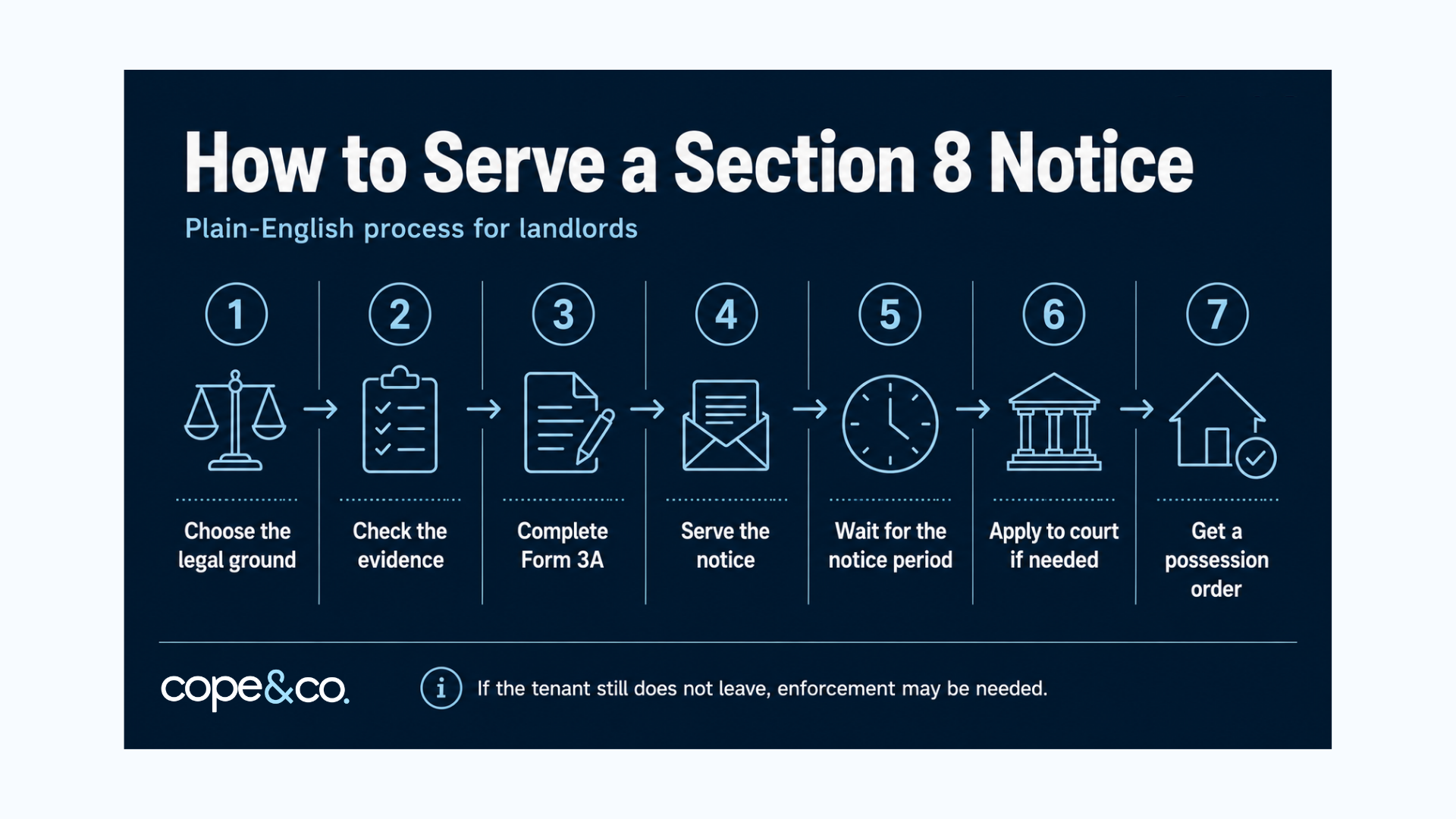
This is the bit that can sound much more complicated than it needs to. In plain English, the process broadly works like this:
Establish why you want the property back. You need a recognised legal ground for possession – for example, selling the property, moving back in, serious rent arrears, certain breaches of the tenancy or anti-social behaviour. Different grounds have different rules.
Check that the ground genuinely applies. Evidence matters. If you are selling, for example, you need to be able to demonstrate a genuine intention to sell. If the claim concerns rent arrears, accurate rent statements become crucial.
Complete the correct Form 3A. The notice must identify the ground being relied upon, explain why it applies and give the correct notice period. Notice periods vary significantly depending upon the ground – from immediate court action in certain anti-social behaviour cases through to four months for grounds such as selling or the landlord moving in.
Serve the notice correctly and keep evidence. Don't simply assume putting something in the post is the end of the job. If the case reaches court, you may need to demonstrate when and how the notice was served.
Wait for the notice period to expire. A Section 8 notice does not physically end the tenancy or give you the right to change the locks.
If the tenant remains, apply to court. Where the claim relates solely to rent arrears, the Government's Possession Claim Online service may be used. Other Section 8 possession claims currently use the paper-based process. Your notice and supporting evidence will form part of the claim.
The court considers the case. If the ground is proved and all applicable requirements are met, the court can make a possession order. If the tenant still does not leave following the order, enforcement through court bailiffs may then be necessary.
That's the process in its simplest form.
The difficulty is that small mistakes at the beginning can create very expensive delays at the end. Wrong ground. Wrong form. Wrong dates. Insufficient evidence. Incorrect notice period. Poor records of service.Any of those can potentially cause a claim to be delayed or fail.

Evidence is becoming just as important as compliance
This is something we expect landlords to hear a lot more about under the Renters’ Rights Act. It is no longer enough simply to say: “I want my property back.”
You need to know the ground you are relying on and, where necessary, be able to demonstrate that it genuinely applies. The same evidence-led approach is becoming increasingly important elsewhere. Rent increases now have their own formal process and tenants have the ability to challenge proposed increases through the First-tier Tribunal.
So good property management is becoming increasingly about creating the evidence before you need it.
Accurate rent schedules. Inspection reports. Communication records. Maintenance histories. Tenant correspondence. Compliance documentation. Evidence of arrears. Properly recorded notices. Trying to reconstruct all of that after something has gone wrong is considerably harder.

What should landlords do now?
We're encouraged that the Government recognises that the courts need more people, better systems and greater capacity, but we aren't going to pretend that means the problem has been solved. The real test will come as greater numbers of new Section 8 possession cases and rent challenges start moving through the system. For landlords, the sensible response is therefore not to wait and see.
Get the tenancy right. Keep the records. Deal with problems early. And if possession becomes necessary, make sure the notice and evidence are right first time.
At Cope & Co., that's exactly how we approach property management. We don't want to start building a possession case when something goes wrong. We want the tenancy file to have been properly managed from day one so that, should evidence ever be required, it is already there.
Need help with a tenancy or worried you may need possession?
If you're a landlord in Derbyshire and you're unsure how the new Section 8 process affects you, talk to Cope & Co. before serving anything. We can review the tenancy, the circumstances and the paperwork, explain the practical next steps and, where specialist legal input is required, help make sure you're pointed in the right direction.
Get in touch with us and let's get it right before a small mistake becomes a very long and expensive one.