

Landlords - Sitting on the Fence About Selling Your Rental Property?
Thinking of selling your rental property? Forget the surveys and headlines. The right decision depends on your finances, your own plans and whether being a landlord still works for you. From rental returns and remortgaging to tax and the Renters’ Rights Act, our practical guide explores what to consider before deciding whether it’s time to move on.
There's always another survey telling us how many landlords are thinking about selling. Another headline about rising costs. Another prediction about the future of buy-to-let. The thing is, none of those surveys knows your mortgage balance, your retirement plans, your tenants or how you feel when the next maintenance email arrives.
We believe the decision starts with one question; does this property still work for you?
For one landlord, keeping a rental will be the right choice. For another, selling will provide freedom, lose some hassle, offer financial security or the opportunity to do something they have been putting off. Of course, both can be sensible decisions.

Why did you buy the property?
Start with your own circumstances. Why did you buy the property, and does that reason still apply today?
Perhaps it was intended to supplement your pension. Perhaps you inherited it. Perhaps you're building a portfolio, helping your children or approaching a stage where you would prefer fewer responsibilities. Your circumstances deserve much more weight than a survey of other landlords. The objective is to establish what keeping the property would give you, what selling would leave you with and which outcome best supports your life.
Here are a number of angles that you should consider to help you make the decision...
Check whether you are receiving a realistic market rent.
Before deciding that the property no longer pays, you need to find out whether its income reflects today’s local market. For example, a property receiving £850 a month when a properly evidenced market rent is £1,000 has a potential gross income difference of £1,800 a year. Could that influence the decision.
Ask for a rental assessment based on comparable properties, location, condition and actual demand. An optimistic asking rent on a portal is only part of the evidence. Then consider your tenant. Someone who pays reliably, looks after the home and wants to stay has real value. Weigh any proposed increase against affordability, the relationship and the potential costs of a change of tenant.
For assured periodic tenancies in England, rent increases must follow the Section 13 process, with at least two months’ notice and no more than one increase a year. Tenants can challenge an above-market increase. A rent review should therefore be planned and properly supported.
Work out what you actually keep
Rent arriving in your bank account is only the starting point. Deduct mortgage payments, management fees, insurance, repairs, service charges where applicable, compliance costs and tax. Allow a realistic reserve for periods without rent and larger future bills. Ask your accountant to check the tax calculation; cash flow and taxable profit are different measures.
Also look at how much equity you have tied up in the property. A rental can produce a positive monthly balance while delivering a modest return on a substantial investment. Compare the likely future return with what you could do with the proceeds after selling costs and tax. Include the risks, access to your money and any future property growth or fall in value. Growth should be a possibility in your planning, rather than something the figures depend upon.
Review the mortgage before making the final decision
If borrowing costs are squeezing the return, speak to a mortgage adviser who understands buy-to-let. A product transfer with your existing lender or a remortgage elsewhere may improve the position. Your property’s value, equity and rental income can affect the options available.
Compare the total cost over the period you expect to keep the loan, including product fees, legal costs and early repayment charges. A lower headline interest rate does not automatically produce the cheapest deal.
If your objective is to release some money, additional borrowing may be worth exploring, subject to affordability and lender criteria. It also increases debt and can reduce the rental surplus. If selling within the next year or two is a realistic possibility, tell the adviser before committing to a new fixed deal. Flexibility may matter as much as the monthly payment.
Calculate the Capital Gains Tax (CGT) before spending the proceeds!
For a personally owned rental property, CGT is generally calculated on the gain after allowable deductions. The outstanding mortgage does not reduce that gain, although repaying it reduces the cash you receive.
For 2026/27, the standard individual CGT allowance is £3,000 across your gains for the year. Taxable residential property gains are charged at 18% to the extent they fall within your unused basic-rate band, and 24% above that. A basic-rate income taxpayer can therefore pay some CGT at 24%.
Here is a simplified example for one UK-resident owner, with the full allowance available, no losses or reliefs and the whole taxable gain falling at 24%:
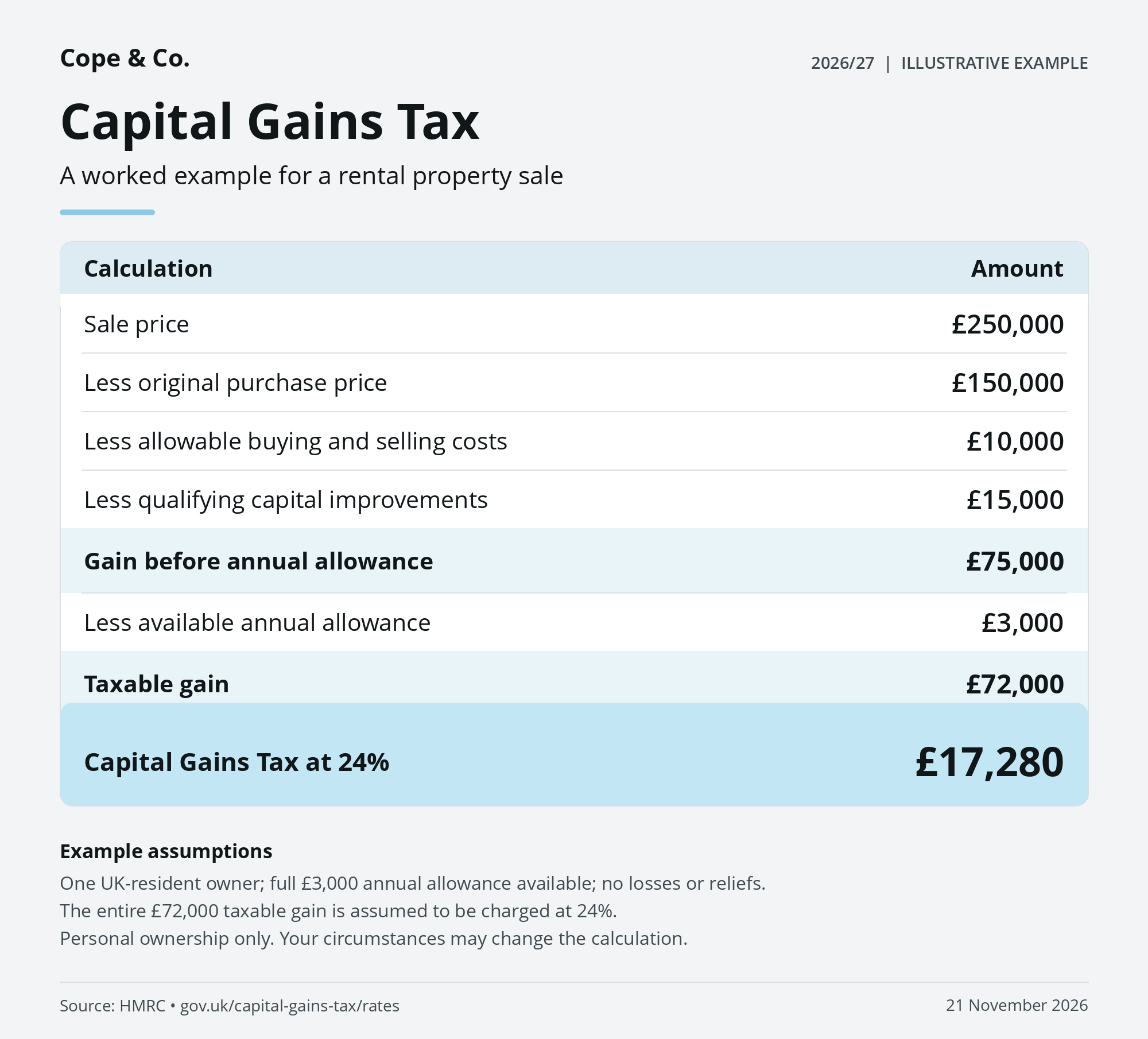
Allowable costs can include estate agency and legal fees and qualifying improvements. Routine maintenance is treated differently, and expenses cannot simply be claimed twice. Joint owners calculate their own shares; previous occupation as your main home and allowable capital losses may also change the result. Definitely get an accountant check your records before committing to a sale.
For personal ownership, any CGT due on a UK residential property sale must normally be reported and paid within 60 days of completion. If you already complete Self Assessment, the sale also needs to appear on that return. The usual online filing deadline is 31 January following the end of the tax year; this does not replace the 60-day property deadline. Non-residents have reporting obligations even where no tax is due.
A company-owned property needs a separate calculation as the company normally pays Corporation Tax on its chargeable gain.
For your decision, ask for an estimate of the money left after repaying the mortgage, paying selling costs and any redemption charges, and setting aside the tax.
Understand how selling works under the Renters’ Rights Act
The Act does not prevent landlords from selling. For most private assured tenancies in England, the main tenancy reforms took effect on 1st May 2026. If you need vacant possession, the essentials are:
- Ground 1A is the selling ground. The Section 8 notice must be based on a genuine intention to sell.
- At least four months’ notice is required, with protection against possession for this reason during the tenancy’s first 12 months.
- The notice does not guarantee possession on that date. Court action, and potentially enforcement, may be needed if the tenant remains.
- Re-letting restrictions apply after using the selling ground, including a 12-month restricted period. You cannot assume that an unsuccessful sale allows you to put the property straight back on the rental market.
Have the tenancy, compliance position and notice checked before setting a timetable. There is also the option of selling with the tenant in place. The buyer becomes the landlord and the existing tenancy continues, so obtaining possession under Ground 1A is unnecessary for that transaction.
Our landlord-to-landlord sales service can help explore this route. It may preserve rental income during the sale and allow the tenant to remain in their home. However, the pool of buyers and achievable price may differ from a sale with vacant possession. Compare both routes on their likely net outcome.
Look at the bills and decisions coming next
A property review should consider more than this month’s income:
- Major expenditure: the roof, boiler, windows, damp issues or planned leasehold works.
- Compliance and energy performance: establish what is required now and budget sensibly for confirmed future requirements.
- Local demand: realistic sale prices, likely selling times and demand for that particular type of rental.
- Financial resilience: whether you could comfortably absorb an empty period, unpaid rent or a substantial repair.
- Your wider portfolio: selling one property may release enough money or reduce enough work without selling everything.
- Your plans for the proceeds: paying down debt, supporting family, retirement or another investment all deserve a considered comparison.
Although not financial, your time and peace of mind also need to be included in that review too!
Consider whether the day-to-day management is the problem
If you still want the investment but are tired of organising repairs, chasing updates and keeping on top of administration, better support may change your experience.
At Cope & Co., we can review the rent, management arrangements and property’s needs, including whether a service such as LetSimple would suit your circumstances. The cost of that support should be included in the figures. Equally, you may simply have reached the point where being a landlord no longer fits your plans.
Before deciding, bring together a realistic sales appraisal, a current rental assessment, a mortgage review and an accountant’s estimate of the tax. That gives you a practical basis for choosing what happens next.
As a trusted letting agent in Derby, we can help landlords across Derbyshire and East Staffordshire assess the property options and plan a sale, including exploring a buyer who will keep the existing tenant. Your rental may have served you well for years. It may have provided income, grown in value or helped your family move forward. You are allowed to decide that it has done its job.
Make the decision with clear figures and a clear understanding of your next step. Then, if selling is right for you, then you can move forward knowing that the decision is the right one.
If it’s time, then it’s time!