

Only 29.5% of Alfreton Homes Have Sold More Than Once Since 1995
Alfreton can look like a busy property market. Boards go up, sold signs appear and new neighbours move in. Yet the records tell a more settled story: fewer than three in ten DE55 homes have sold more than once since 1995. The real insight lies in the homes that return to market, and the many that do not. Read the blog to see why this is important.
Drive around Alfreton and it is easy to assume that people are constantly moving. A for sale board appears, the photographs go online and, before long, a sold slip follows. Because that activity is so visible, it can make the whole market feel more fluid than it really is.
Look beyond the boards and a different picture emerges. Large parts of Alfreton's housing stock have changed hands only once since 1995, or not at all in recorded sales data. It is a useful reminder that the local property market moves at two very different speeds.

Less than a third of Alfreton homes have sold more than once
Across DE55, there are 29,031 homes. Of these, 8,558 have recorded at least two sales since 1995.
That represents 29.5% of the local housing stock. The national figure is 25.5%, so Alfreton has a slightly higher proportion of repeat-sale homes than the wider average. Even so, the visible flow of listings and sold boards is still being created by fewer than one in three homes.
Some of those properties have returned to the market several times. Others sold once and then remained with the same owner for decades. Many have not appeared in the recorded sales data at all.

What the 5.4-year figure actually means
Among the 8,558 repeat-sale properties, the average gap between recorded sales was 1,983 days, or approximately 5.4 years. That does not mean the average Alfreton homeowner moves every 5.4 years. The figure is calculated only from properties with at least two recorded sales during the period from 1995 to 2026.
A home with one recorded sale is not included. Neither is a property that remained with the same owner throughout the whole period. The figure therefore measures turnover within the repeat-sale part of the market; it is not the average length of ownership across every home in Alfreton.

Why some homes return to the market sooner
Different types of property often play different roles in a local market.
Flats, terraces and more affordable semi-detached homes frequently suit buyers at an earlier stage of homeownership. They may work perfectly for several years, but life moves on: relationships develop, families grow, work changes and the need for another bedroom, a larger garden or more parking becomes more important.
Larger detached homes, bungalows and established family houses can follow a different pattern. They are often bought later, when people have a clearer view of their long-term needs. Once the space, location and layout are right, there may be far less reason to move again.
That does not make every smaller home a stepping stone, or every larger home a forever home. But across thousands of transactions, the mix of property types within a postcode can influence how regularly homes come back to the market.

Are Alfreton's repeat-sale homes more affordable?
The repeat-sale properties had an average latest recorded sale price of £216,017. The estimated average value across all Alfreton homes is £251,079.
On the surface, that may suggest that homes changing hands more frequently tend to sit towards the more affordable end of the market. There is some logic to that, particularly where first-time buyer and early family homes make up a larger share of repeat sales.
However, the figures are not a direct like-for-like comparison. A property's latest recorded sale may have taken place several years ago, while the £251,079 figure is an estimate of what the wider housing stock is worth today. Timing, condition, size, property type and location can all influence the difference.
The sensible conclusion is not that every repeat-sale property is cheaper. It is that lower-priced homes may circulate more regularly, while larger or more established homes are more likely to remain in the same hands for longer.

How DE55 compares with nearby postcode districts
The neighbouring figures show a broadly similar pattern, with only modest differences in the average gap between repeat sales.
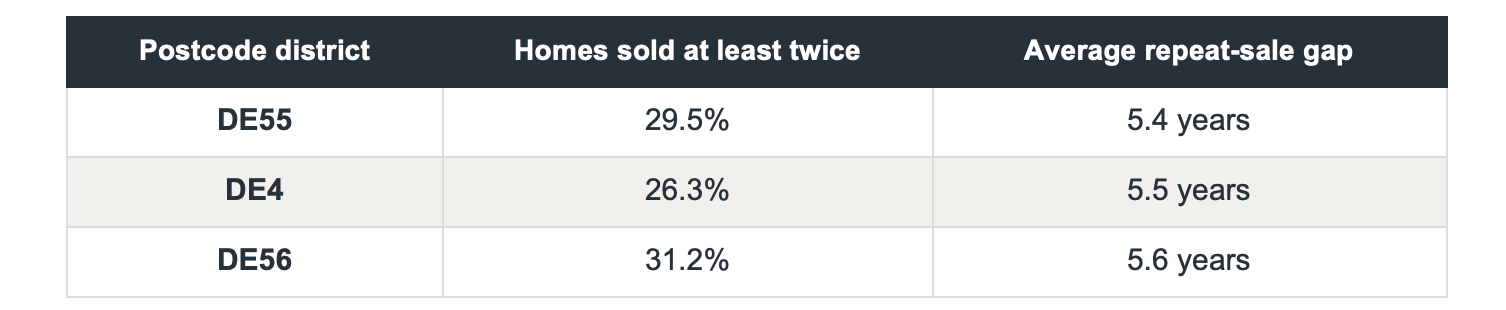
The average gap is calculated only for homes with at least two recorded sales since 1995; it is not the average residency of all households.

The bigger story: the homes that have barely moved
Of Alfreton's 29,031 homes, 6,318 have recorded just one sale since 1995, while a further 14,155 have no recorded sale during the period.
Together, that means 20,473 homes - 70.5% of the local housing stock - have either sold once or have no recorded sale since 1995. That is the quieter side of the Alfreton market, and arguably the more revealing one.
The no-sale category needs careful interpretation. Around one-third may be council or housing association properties. Some private homes will have been bought before the records began and remained with the same owner ever since. There will also be transactions that do not appear as conventional open-market sales.
Even allowing for those points, the scale is striking. Behind many Alfreton front doors may be owners who bought in the 1970s, 1980s or early 1990s and have never moved. They have seen their street change, families grow up, neighbours come and go and property values rise, all without their own home returning to the market.

What this means for today's Alfreton market
For buyers, it helps explain why certain streets, house types or plots can feel so difficult to find. When a well-kept home comes to market after many years, it may attract attention precisely because opportunities like it are limited.
For sellers, it is a reminder that a postcode average is only a starting point. A home that has not sold for decades may have very few direct comparisons. Its condition, improvements, plot, outlook, layout and current buyer demand all need to be considered before a sensible asking-price strategy can be set.
At Cope & Co., we believe the best property decisions start with clear evidence and an honest conversation - not a headline valuation. Understanding how your particular home sits within the local market is far more useful than relying on a broad average alone.
In a future article, we will look more closely at the Alfreton homes with no recorded sale since 1995, separate likely social housing from long-term private ownership and explore how much of the town may have remained behind the same front door for more than 30 years.
Sometimes the most revealing story in a property market is not how often people move. It is how many never do.

Thinking about a move in Alfreton?
A tailored market appraisal will tell you far more than an online estimate. Cope & Co. can help you understand recent comparable sales, current buyer demand and the best way to position your home.