

Tax Landlords Again. Watch Tenants Pay.
Another tax rise for landlords. Another squeeze on tenants? The latest Budget risks pushing up rents and reducing choice. At Cope & Co, we explain how higher costs can become higher market rents, why the rents achieved by some landlords influence others, and why tenants could ultimately pay the price for a policy aimed primarily at property owners.
Another Budget. Another tax increase for landlords, and another reason to worry about what tenants will ultimately pay. Quite frankly, I'm astounded!
A healthy rental market needs good homes, responsible landlords and enough choice to keep rents competitive. Increasing the tax burden on the people providing those homes risks making all three harder to achieve.
Across all the property media, the latest announcement has prompted widespread concern across the property sector about investment, rental supply and affordability. We share those concerns.
Our view is straightforward: a tax bill addressed to a landlord can still find its way into a tenant’s monthly outgoings.
The government has announced a further 2% increase in property income tax, on top of the increase announced last year. The proposed rates, due to take effect from 6 April 2027 through the forthcoming Finance Bill, are:
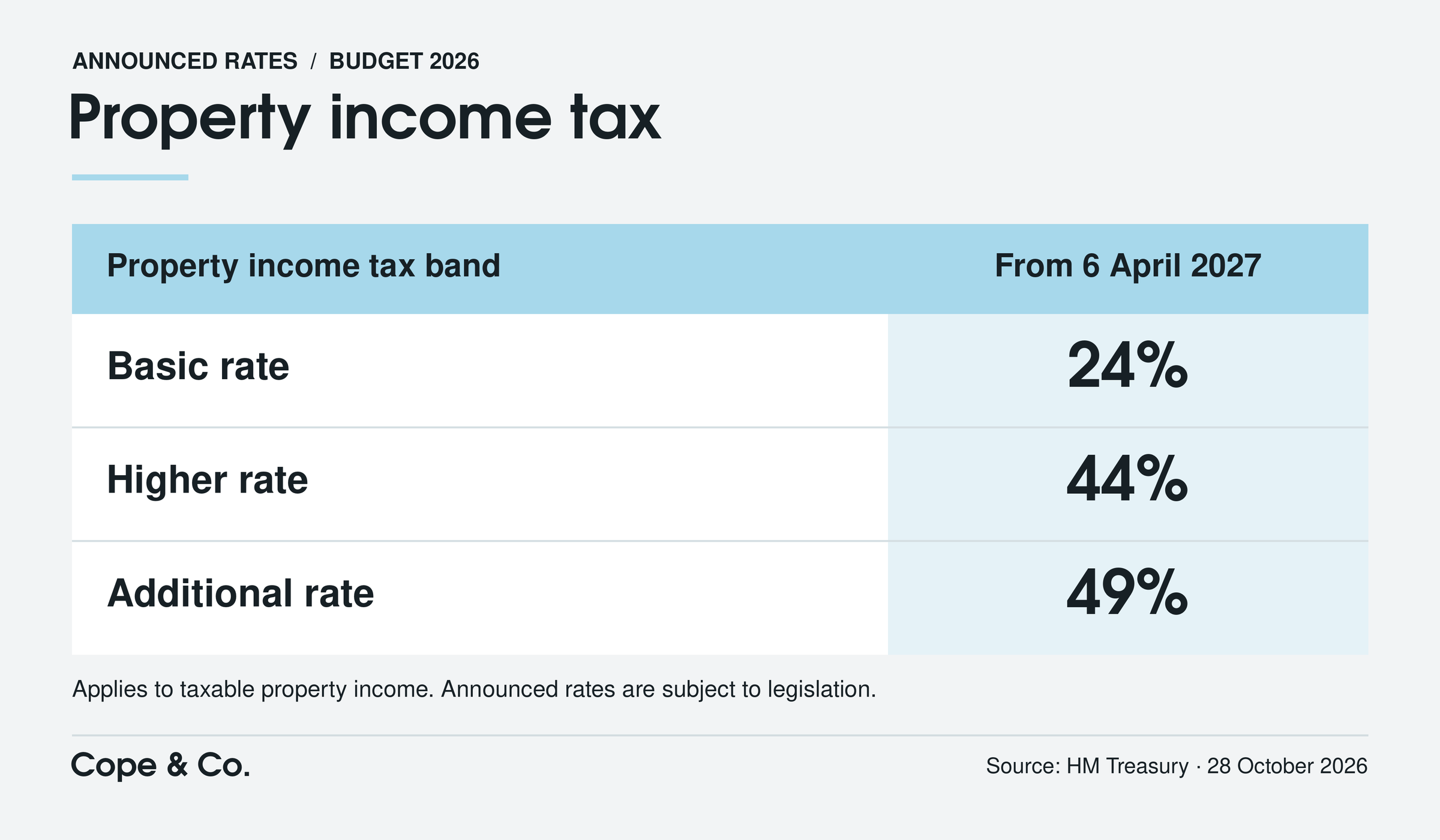
To clarify, it applies to taxable rental profit, rather than the total rent collected. Allowable expenses such as letting fees, repairs and insurance are deducted first. These rates apply to taxable property income under the income tax system, rather than being a flat deduction from every rent payment. The announcement concerns England, Wales and Northern Ireland, with separate devolved arrangements to consider.
The previously announced rates were 22%, 42% and 47%. That first increase has not even taken effect, yet the government has already announced another. The combined increase is four percentage points above the current rates.
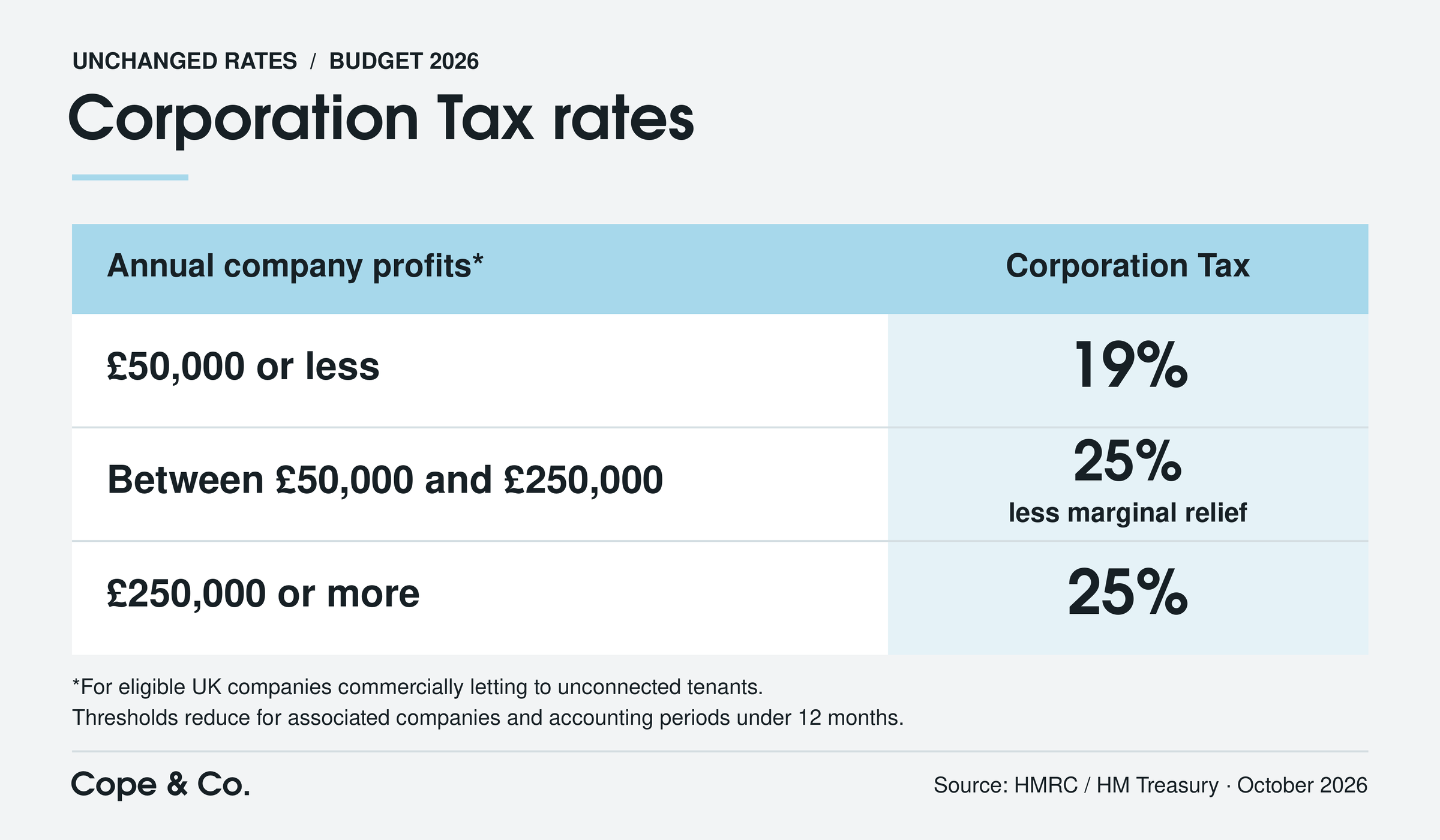
The Corporation Tax rates for limited companies holding rental properties remain unchanged by this Budget. The announced 24%, 44% and 49% property-income tax rates do not apply to company rental profits.
For an eligible UK company, the usual position remains:
For landlords trying to plan ahead, that is deeply frustrating. Property investment involves commitments measured in years. Repeated changes to the financial calculation make those commitments harder to justify. But how does a higher tax bill translate into higher rents?
The crucial point is that the market determines what rent a property can achieve.
A landlord cannot simply calculate their extra tax, add it to the rent and assume a tenant will pay. Location, condition, competing properties, demand and household budgets all matter. An ambitious asking rent achieves very little if the property remains empty.
However, the market is constantly moving. The rents being achieved today help establish the evidence used to assess comparable homes tomorrow.
Consider this illustrative example, using hypothetical figures:
🔹 Similar homes in an area have been letting for around £900 per month.
🔹 Some landlords, facing lower returns, advertise their next available properties at £950 per month.
🔹 If those homes attract tenants and actually let at £950, those completed lettings provide evidence that the higher rent is achievable.
🔹 Other landlords independently review that evidence and price comparable homes accordingly. If those properties also let at the higher level, the market benchmark moves upwards.
The difference between asking and achieving is everything.
One overpriced advert does not establish a new market rent, however, a pattern of comparable homes successfully letting at higher prices can. That is how a cost increase affecting some landlords can eventually influence rents across a wider market. Even landlords whose own costs have barely changed may review their rents against the new evidence.
There are limits. Tenants’ incomes do not rise simply because landlords’ tax bills do. Where demand cannot support higher rents, landlords may have to accept lower returns. Some will retain a reliable tenant at a lower rent because continuity has real financial value.
The outcome will vary between locations and properties. But where suitable homes are scarce and demand remains strong, there is more scope for higher asking rents to become higher achieved rents.
Existing tenants also have legal protections. In England, landlords need to use the Section 13 process for assured periodic tenancies, give at least two months’ notice and increase rent no more than once a year. Tenants can challenge a proposed increase above the open-market rent. However, a limit based on market rent still allows increases when the market itself rises. It does not freeze the local benchmark.
There is also the question of supply.
If the financial return becomes less attractive, some landlords may abandon a planned purchase or decide to sell. A sale to another landlord can preserve the rental home. A sale to an owner-occupier changes its use and may also remove a household from rental demand. The overall effect depends on who buys and what happens next.
The longer-term concern is whether investment supplies enough rental homes for the households that need them.
The Office for Budget Responsibility has identified this risk. Its October assessment warns that the cumulative effect of measures reducing landlord returns could discourage new entrants, encourage departures and contribute to higher rents over time and that should give policymakers pause.
For tenants across Derby, Alfreton, Burton-on-Trent and the surrounding areas, the practical concerns are finding a suitable home, being able to afford it and feeling settled once they move in. Policies that weaken investment in rental housing risk making those everyday priorities harder to achieve.
I believe responsible landlords and tenants both benefit from a stable, well-supplied rental market. Good homes need maintenance, investment and owners willing to remain in the sector. Tenants need choice and rents that leave room for the rest of life. We would like to see policy that supports those shared interests. Another tax increase feels like a deeply disappointing step.
For landlords, the sensible response is to review the numbers carefully: understand the likely tax impact with your accountant, assess your property’s actual rental position and consider the value of retaining good tenants. A rushed rent increase or sale deserves more thought than a Budget headline.
If you own rental property in Derbyshire or East Staffordshire, speak to Cope & Co. We can help you assess achievable rent, review how your property is performing and plan your next steps.