
The First 8 Weeks Could Make or Break Your Alfreton House Sale
Almost 2 in 3 Alfreton homes that sell, find a buyer in the first 8 weeks. Yet many sellers often agree to a 26-week estate agency contract. Why! In this blog we examine the figures, discuss why early momentum matters and how the right launch price can mean the difference between moving smoothly and months of repeated reductions.
If you are thinking of selling your Alfreton home, there is one number worth remembering: 56 days.
The average Alfreton property currently takes 89 days to sell, compared with a national average of 75 days. Yet, with the help of Denton House Research, we've found that 61.7% of all UK homes that eventually sell have already found a buyer within their first eight weeks on the market.
At first glance, those figures seem to clash. If almost two out of every three successful sales are agreed within 56 days, how can the average stretch to 75 days nationally and 89 days in Alfreton?
It's because an average blends together two very different experiences. Plenty of homes sell quickly. Others sit on the market for three, four, five or six months, sometimes longer. Those slower listings keep adding days and pull the average upwards.
So the most useful question is not, "How long does the average sale take?" It is: "What happens during the first eight weeks?"

Your strongest selling window starts on day one
When a home first launches, it has something it can never get back; freshness.
It lands in buyers' property alerts, agents contact active applicants and motivated purchasers are curious to see it. That early wave of attention is your best opportunity to create viewings, second viewings, competition and offers.
Denton House Research analysed more than 900,000 UK sales agreed last year. The proportion of all sales agreed in each week of marketing was:
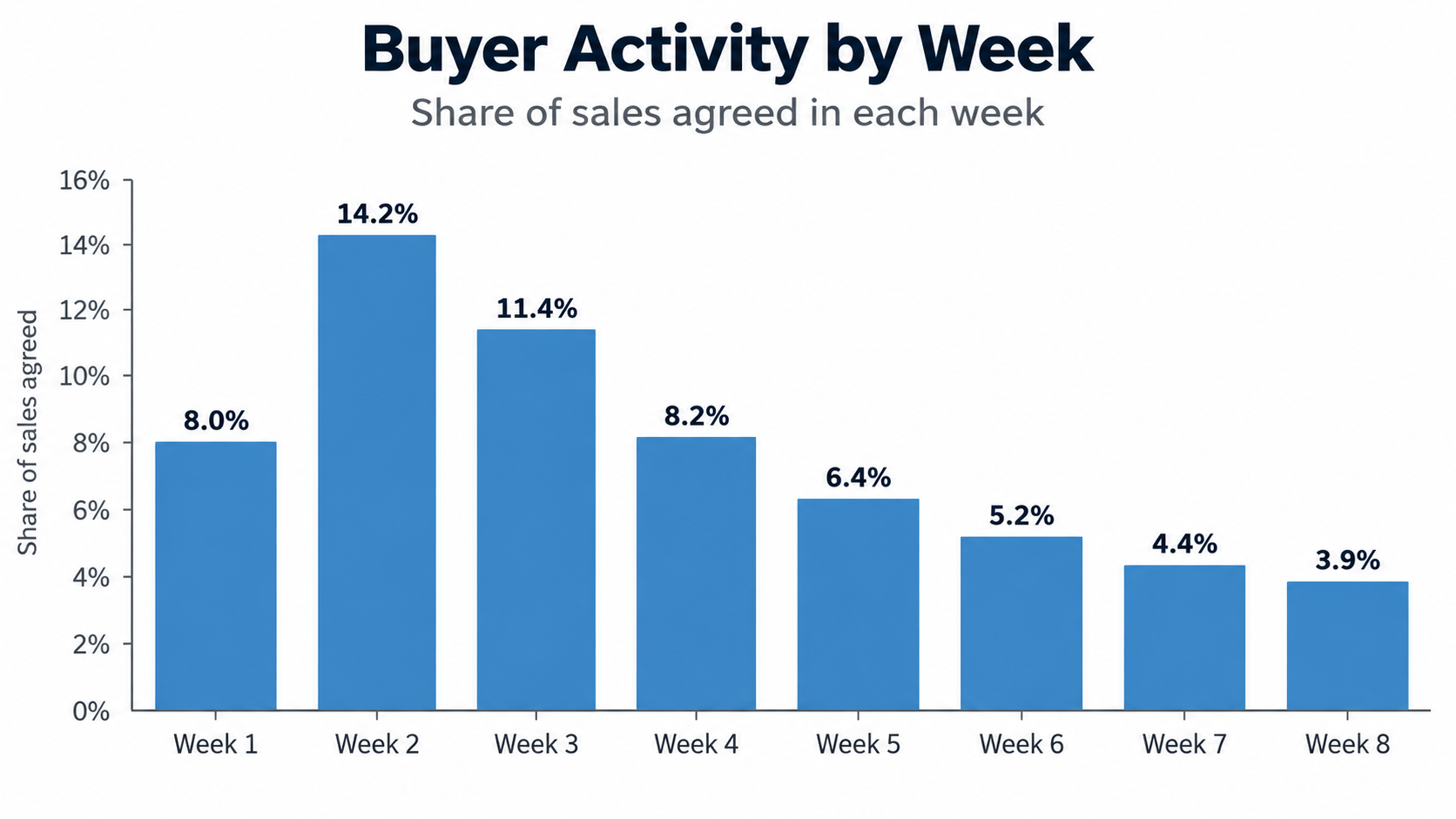
Add those figures together and 41.8% of all UK sales are agreed within the first four weeks, rising to 61.7% within the first eight weeks.
Your Alfreton home can still sell after day 56, of course. But the market around it has changed. Many of the most active buyers have already seen it, considered it and either viewed it or moved on. The property has also started to build a visible marketing history.

What is happening in the Alfreton market right now?
38% of the homes currently for sale in Alfreton - more than one in three - have been marketed for at least 8 weeks, or, 56 days.
When an Alfreton home first comes to market, it currently has a 63% chance of achieving a sale agreed - roughly six chances in ten.
Once it has been on the market for eight weeks or more, that chance falls to 21% - around one in five.
That does not mean every older listing is doomed. It does mean sellers should treat early feedback as valuable evidence rather than waiting and hoping the same strategy will suddenly start working.

Why the average can give sellers false comfort
It is easy to look at the 75-day national average and think there is no need to worry if your home has not sold after two months. The data suggests the opposite.
By week 16, only 1.5% of sales are being agreed in any individual week.
By week 26, that falls to just 0.6%.
If a property reaches week 12 without selling, it has only around a 14.5% chance - roughly one in seven - of eventually securing a sale.
The market can be surprisingly binary; secure the right buyer early, or prepare for a much longer and more difficult journey.
Once an Alfreton property has been sitting online for several months, buyer psychology changes. Instead of seeing an exciting new opportunity, buyers may start asking why nobody else has bought it. They may wonder whether something is wrong, whether the seller is difficult to deal with or whether a sizeable discount is available.
Most of the time, there is absolutely nothing wrong with the home. More often, it was simply launched at the wrong price.

You only get ONE first impression
This is why I am wary of advice to "test the market" at a higher figure and reduce later. Testing is not the problem, provided the test is short, the response is measured honestly and the seller is prepared to act.
Therefore, a test of two weeks, three at the very most, may not seriously damage saleability. Move beyond the four or five-week threshold without responding, however, and the chance of selling drops sharply.
If your Alfreton property launches at a slightly ambitious price, the first fortnight will usually tell you plenty.
Are you receiving good-quality enquiries? Are buyers booking viewings? Are people returning for second visits? Is there genuine competition?
Silence is feedback too. If the market is not responding, the price conversation should happen while the listing still feels new - not after eight, twelve or twenty weeks. By then, you have not simply tested the market. You have tested its patience.
There is always the 'Is there something wrong with it?' question for overly large and frequent reductions so be very wary of this strategy.

What is the point of a 26-week agency contract?
Yes. They do exist! Half a year to agree a sale?
It is a question every Alfreton seller should ask before signing on the dotted line if offered a long term agency agreement.
Put bluntly, a 26-week agency tie-in can be the safety net for an agent who intends to overvalue your home from the outset simply to win the instruction, then use a series of price reductions to bring the asking price back towards the level it should have been at in the first place.
The pattern is straightforward; promise a headline-grabbing asking price, secure the seller on a long contract, wait for the weak response, recommend a reduction and then recommend another. Eventually, the property reaches a price that may have attracted a buyer at launch, but by then the crucial early window has been wasted and the listing has acquired a history.
That is not a seller-first pricing strategy. It is an instruction-winning strategy protected by a long contract.
In my view, a good agent should be confident enough in their valuation, marketing and service not to need to lock a homeowner in for half a year. They should be able to show the evidence behind the asking price, explain what the home is competing against and agree clear review points from the start.
Before agreeing to a lengthy tie-in, ask:
⚠️ Exactly how long am I committed to this agent?
⚠️ How much notice would I need to give if the service does not deliver?
⚠️ What will the agent do during the crucial first two or three weeks?
⚠️ What evidence would trigger a review of the price or marketing?
⚠️ What freedom do I have if the promises made at the valuation are not kept?
A long contract can make it far too easy for an inflated valuation to become the seller's problem. The best valuation is not the biggest number an agent can say in your living room. It is the figure that gives your home the strongest chance of attracting the right buyer.
If you're thinking it... Cope & Co. offer a ZERO WEEK CONTRACT!

The Alfreton evidence supports getting it right first time
Of the Alfreton homes that came onto the market in 2026 and subsequently went Sold, Sale Agreed or Sold Subject to Contract, 80.1% secured their buyer without a price reduction.
That is powerful evidence. In the vast majority of successful local sales this year, the property did not need to chase the market downwards because it was positioned correctly from the outset.
Correct pricing does not mean cheap pricing. It means credible, competitive and evidence-based pricing.
There is another reason those early weeks matter, and it is often overlooked. A property becoming Sold Subject to Contract is not the same as the sale reaching exchange and completion.
When a sale is agreed within the first 25 days of marketing, figures show around a 94% chance - 19 out of 20 - of the sale proceeding to exchange and completion.
When it takes more than 100 days to agree a sale, the chance of reaching exchange and completion falls to around 56% - just 11 out of 20.
That is a huge difference. The objective is not simply to receive an offer at some point. It is to find the right Alfreton buyer early enough, maintain momentum and give the sale the best possible chance of reaching the finish line.

Pricing correctly is not giving your home away
Alfreton is not one single property market. Different streets, property types and price brackets can behave very differently. An accurate valuation is not simply a matter of finding what a similar house sold for six months ago and adding a percentage.
You need to understand what buyers are comparing your property with today, what else is available today and how much demand exists at the price you are considering. The asking price is not just a number on the property particulars. It is a central part of the marketing strategy.
Price too low and you may undersell. Price too high and you risk wasting the period when buyer attention is strongest. The job of a good estate agent is to find the sweet spot: a price that protects the value of your home while creating enough interest to produce a committed buyer.

What should Alfreton sellers take from this?
Do not let the 75-day national average persuade you that there is plenty of time. That figure combines homes that sell quickly with properties that take many months to find a buyer, and those are two very different experiences.
Focus instead on the first eight weeks - the first 56 days. Launch with an evidence-backed asking price, present the property at its best and make sure the marketing creates the strongest possible first impression. Watch the response closely. If buyers are engaging, great, build on that momentum. If they are not, do not wait until the listing has become stale before making a decision.
Most importantly, do not allow a flattering valuation and a 26-week tie-in to take away your control. Choose an agent whose advice is supported by evidence and whose strategy is designed to get you moved, not merely to get your signature.
Getting the price right from day one is not about selling your Alfreton home cheaply. It is about giving yourself the best possible chance of securing a committed buyer, reaching exchange and completion and actually moving home.
The first eight weeks are not the warm-up. They are your best opportunity, so make them count.