
What’s Happening in the Derbyshire Property Market?
As we come up to the end of July 2026, what’s really happening in the Derbyshire property market? We’ve reviewed the latest figures for Derby, Alfreton and the wider county to explain how prices, buyer demand and rents are changing, and more importantly, what the data could mean for sellers, buyers and landlords right now...
A plain-English look at the latest property data for Derby, Alfreton and the wider county
The Derbyshire property market is still moving in a positive direction, but it is becoming more balanced.
Official figures show that average property prices are higher than they were a year ago across every part of Derbyshire. At the same time, homes are generally taking longer to find a buyer, and people searching for a property are becoming more careful about what they are prepared to pay.
In simple terms, this is not a market where sellers can choose almost any asking price and expect their home to sell. However, well-presented properties marketed at a realistic price are still attracting interest.
Here is what the latest available data tells us, and, more importantly, what it could mean for homeowners, buyers and landlords in Derby, Alfreton and across Derbyshire.

How we assess the Derbyshire property market
Property market headlines can sometimes appear confusing. One report may say prices are rising, while another suggests asking prices are falling or homes are taking longer to sell.
This usually happens because different reports measure different stages of the property journey.
To provide a clearer and more balanced picture, we use a three-layer market model when reviewing property conditions across Derbyshire, including Derby, Alfreton and the surrounding areas.
Layer one: confirmed property price trends
We begin with the UK House Price Index, which uses completed and registered property sales to show how values are changing over time. This helps us understand the wider direction of the market in places such as Derby and Amber Valley, which includes Alfreton.
It is one of the most reliable ways to compare annual price movements because it is based on properties that have actually sold, rather than the prices sellers originally hoped to achieve.
Layer two: what buyers have actually paid
We then examine HM Land Registry completed-sale records. These records allow us to look more closely at the prices paid for detached, semi-detached, terraced and leasehold properties. They also help us compare individual neighbourhoods and nearby streets.
This is particularly important when assessing local property markets such as Derby and Alfreton, where values can vary considerably over a relatively short distance.
A broad Derbyshire average cannot reflect the difference between individual roads, property styles, school catchments, transport links or levels of local demand.
Layer three: what is happening in the market now
Finally, we review more immediate indicators, including new asking prices, the number of properties entering the market and how long homes are taking to find a buyer. Sources such as Rightmove and Zoopla provide a useful view of current seller confidence and buyer activity.
These figures are more up to date than completed-sale records, although they measure asking prices and market behaviour rather than final sale prices.
By combining all three layers, we can separate long-term property price movements from short-term changes in buyer demand. This gives homeowners, buyers and landlords a more useful answer to the question that matters most:
What does the Derbyshire property market, and more specifically, the market in Derby or Alfreton, mean for my plans?

House prices are still rising across Derbyshire
The latest official UK House Price Index figures cover May 2026.
They show annual property price growth across all nine Derbyshire local authority areas, including Derby city. North East Derbyshire recorded the strongest increase, with the average property price rising by 10.6% over the year to approximately £255,000.
Other areas showing relatively strong growth included:
📈 Derbyshire Dales, up 6.5% to £343,000
📈 Amber Valley, up 6.1% to £236,000
📈 South Derbyshire, up 5.9% to £261,000
📈 Chesterfield, up 5.6% to £203,000
Derby recorded the slowest annual increase, with average prices rising by 2% to around £205,000.
Derbyshire Dales remains the most expensive part of the county, while Bolsover continues to offer some of the most affordable homes, with an average property price of approximately £187,000.
For homeowners in Alfreton, the Amber Valley figure provides a useful indication of the wider direction of the local market. However, it should not be treated as an exact measure of how much every home in Alfreton has risen in value.
The same applies in Derby. A city-wide average cannot fully reflect the differences between individual neighbourhoods, streets and property types. The value of an individual home will still depend on its location, size, condition, presentation, parking, outside space and the level of demand from local buyers.

What are buyers actually paying?
Official house price figures are useful for showing the overall direction of the market. However, it is also helpful to look at the prices buyers have actually paid for completed sales.
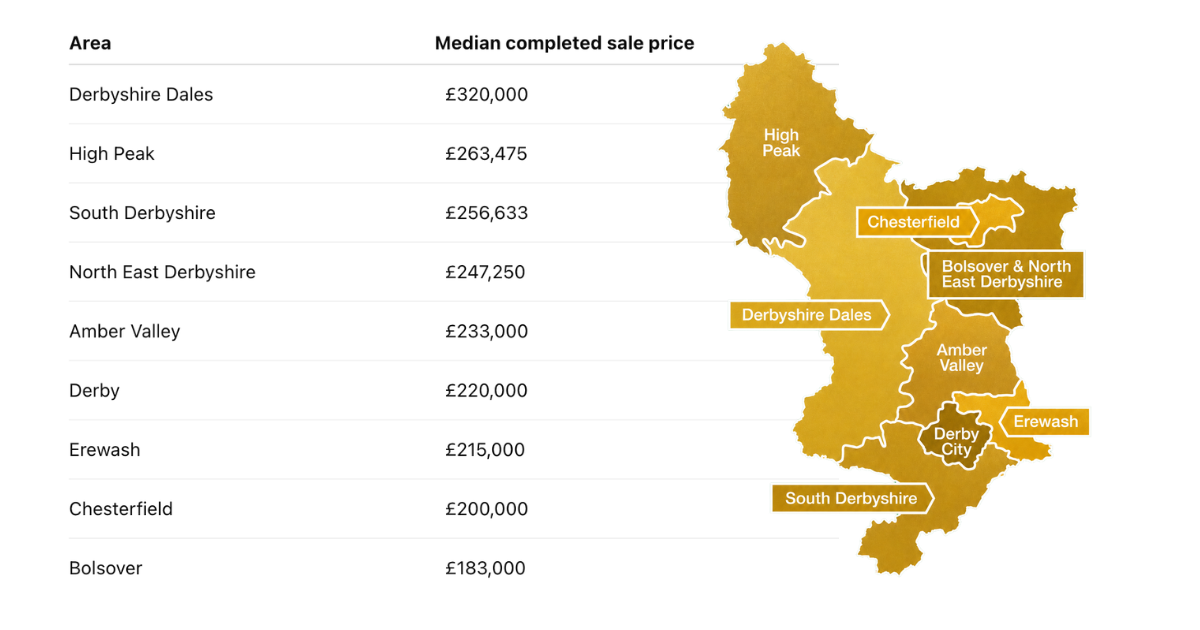
HM Land Registry records show that the median completed sale price across Derbyshire during 2025 was approximately £230,000.
A median is the middle figure when all sales are placed in price order. It is often more useful than a simple average because it is less affected by a small number of unusually expensive properties.
The typical completed price varied considerably between different parts of the county:
Across the county, the median completed price for a detached home was approximately £340,000.
Semi-detached properties had a median price of around £212,000, while terraced homes were approximately £170,000. The median price for a flat or maisonette was around £130,000.
These figures demonstrate why local knowledge matters.
For example, the Derby median of £220,000 provides a useful city-wide benchmark, but it does not mean that all properties in Derby should be valued at a similar level.
Likewise, the Amber Valley median of £233,000 offers useful context for the Alfreton property market, but prices within Alfreton and its surrounding villages will vary according to the exact location and type of home.
Even within the same postcode area, two similar-looking properties can achieve very different prices depending on their condition, road, school catchment, parking, plot size and nearby amenities.

The market is becoming more price-sensitive
The completed-sales figures remain positive, but the latest asking-price data provides a more immediate picture of current market conditions. Rightmove’s July 2026 figures show that the average price of a newly listed property in the East Midlands was approximately £291,470. This was:
📉 1.1% lower than the previous month
📉 0.3% lower than a year earlier
⏳ accompanied by an average selling time of 68 days
These figures do not mean that completed property values have suddenly fallen across Derbyshire.
Asking prices measure what sellers hope to achieve when a property first comes to market. Completed-sale data records what a buyer eventually pays, often several months later.
However, the fall in new asking prices and the longer time needed to find a buyer suggest that sellers are having to be more realistic.
Buyers in Derby, Alfreton and the wider Derbyshire area generally have more choice than they did during the fastest-moving periods of the market. They are also paying closer attention to a property’s condition, running costs, energy efficiency and value compared with other homes nearby.

What does this mean for sellers?
The positive news is that Derbyshire property values remain supported, with official figures showing annual growth throughout the county.
However, the market is unlikely to reward an overly ambitious asking price.
A property that is priced too high at the beginning may receive fewer viewing enquiries, remain online for longer and eventually need a reduction.
Buyers can often see how long a home has been advertised and whether its asking price has changed. This may affect how they approach negotiations.
Start with a realistic asking price
Your asking price should reflect recent comparable sales, the condition of your home and the properties you will be competing against. It should not be based solely on the highest price achieved nearby or on the amount you would ideally like to receive.
For sellers in Derby or Alfreton, this means looking beyond broad city or district averages. The most useful evidence will usually come from recent sales of similar homes in the immediate area, supported by an understanding of what local buyers are currently searching for.
Make the first impression count
Good photography, tidy presentation and clear marketing remain extremely important.
When buyers have more properties to choose from, homes that look dark, cluttered or poorly maintained can be quickly overlooked. Small improvements such as cleaning, decluttering, touching up paintwork and improving the entrance can make a significant difference to the way a property is received.
Pay attention to early feedback
The first few weeks on the market are important.
A lack of enquiries or viewings may indicate that the price, presentation or marketing approach needs to be reviewed. Acting early is generally more effective than waiting several months before making a change.
Be prepared for sensible negotiation
Buyers may feel more confident making offers below the asking price, particularly where a property needs work or has been available for some time.
This does not mean accepting an unnecessarily low offer.
It means considering the strength of the buyer’s position, the level of competing interest and your own moving plans, not just the headline figure.
A proceedable buyer with a mortgage agreement in principle and a short chain may sometimes represent a stronger option than a higher offer from someone in a less secure position.

What does this mean for buyers?
Current market conditions may give buyers more breathing room than they had during the most competitive periods of the market.
There may be more opportunity to compare properties, arrange additional viewings and negotiate where a home is overpriced or requires improvement. However, buyers should not assume that every seller will accept a large reduction.
Well-priced homes in popular parts of Derby and Alfreton can still attract strong interest, particularly affordable two- and three-bedroom houses suitable for first-time buyers, couples and families. Buyers should:
☑️ Obtain a mortgage agreement in principle before making an offer
☑️ Research recently completed sales rather than relying only on current asking prices
☑️ Consider likely repair, improvement and energy costs
☑️ Keep their position as straightforward as possible
☑️ Avoid losing the right property over a relatively small difference where the price is supported by local evidence
The key is to negotiate confidently but realistically. An asking price is not always the final price, but a low offer should still be supported by evidence.

What does this mean for landlords?
Rental growth remains positive across Derbyshire, although the rate varies considerably between areas. The strongest annual rental increases were recorded in:
📈 Derbyshire Dales, up 6.8%
📈 Bolsover, up 6.7%
📈 High Peak, up 5.8%
📈 South Derbyshire, up 4.2%
For landlords considering Derby or Alfreton, wider area figures are a helpful starting point, but they do not tell the whole story. Tenant demand can vary according to property type, proximity to employment, transport connections, schools, local amenities and the condition of the property.
A well-located two-bedroom house may perform very differently from a large apartment or a property requiring significant maintenance. Landlords should not judge an investment opportunity by rent growth alone. A lower-priced property with steady tenant demand may offer a stronger yield than a more expensive property in an area with faster rent increases.
Landlords and investors should consider:
➜ The achievable rent for that particular property
➜ The purchase price and mortgage cost
➜ Maintenance and refurbishment requirements
➜ Energy efficiency
➜ Potential void periods without a tenant
➜ Local tenant demand
➜ Management and compliance costs
The strongest investment is not always the property with the highest rent. It's the one where the income, costs, demand and long-term prospects work together.

What is the outlook for the Derbyshire property market?
The Derbyshire market appears stable rather than bouncy.
Official completed-price data remains encouraging, but the latest asking-price and sales-activity figures suggest that the pace of growth may slow.
We are likely to see a greater difference between properties that are priced and presented correctly and those that are not. Homes offering good value in desirable parts of Derby, Alfreton and the wider county should continue to attract buyers. Properties that are overpriced, poorly presented or difficult to finance may take considerably longer to sell.
For sellers, the message is to price carefully and prepare properly.
For buyers, there may be more time and room to negotiate, but good properties will still face competition.
For landlords, demand remains healthy in many areas, although every investment should be assessed using realistic rental and cost figures.

Thinking of moving in Derby, Alfreton or Derbyshire?
Market-wide figures are a useful starting point, but they cannot provide an accurate valuation for an individual home.
The right asking price depends on recent sales in your immediate area, the properties currently competing for buyers and the features that make your home different.
The Cope & Co. team can provide a local, evidence-based assessment of your property and explain how current market conditions may affect your plans. Whether you are thinking of selling a property in Derby, buying a home in Alfreton or reviewing a rental investment elsewhere in Derbyshire, speaking to someone who understands the local market can help you make a more informed decision.
Data used in this update includes the UK House Price Index, HM Land Registry Price Paid Data, Rightmove and Zoopla. Figures were the latest available when reviewed on 23 July 2026. Official figures may be revised, and asking prices should not be confused with completed sale prices.